 Looksrare
 rewards require separating displayed estimates from recorded results
Looksrare rewards can appear as pending estimates, claimable balances, completed claims, or historical campaign totals. The displayed figure answers what the interface currently calculates for the connected address. A recorded result reflects contract and token state at a chosen block. Match the same wallet, program, reward asset, network, and observation time before comparing them. For an executed claim, require a successful receipt plus the resulting transfer or state update; for a commitment, require a successful receipt and the resulting committed balance or contract state. Gas and other execution costs sit outside the headline reward number. Historical trading, listing, or seasonal screens must not be blended with the current protocol route because each uses different eligibility and settlement rules.
In short: Treat a dashboard reward as an indication of its labeled state; confirm any claimed or committed outcome with the matching transaction record and resulting contract state or token balance.
Matching Terms for Displayed and Recorded Results
Displayed figures support planning, while recorded evidence supports reconciliation. A displayed amount may answer whether an address appears eligible, how much is pending, or what the interface expects to become claimable. Contract state, transaction receipts, emitted events, and token balances answer whether the corresponding action occurred. Compare both paths using the same wallet address, reward program, asset, network, and block or time boundary.
The live protocol-rewards route presents committing LOOKS as the participation action. That route should be evaluated against its own displayed terms and recorded commitment state. An archived trading total, an old listing score, or a completed seasonal balance belongs to another mechanism. Similar labels do not make those figures interchangeable, and combining them can produce a total that no contract or wallet record supports.
Why Can the Reward Figure Change Before a Claim?
A reward figure can change because the inputs behind the display continue to move before settlement. Depending on the active program, those inputs may include the committed balance, total participation, newly allocated rewards, elapsed distribution time, or an updated eligibility record. A projected rate can also move without changing the amount already recorded for the wallet.
Presentation adds another source of variation. The interface may read indexed data that trails the latest block, cache an earlier response, or briefly show no account-specific value after the wallet or network changes. Refreshing can replace that view with a newer calculation. Such a change establishes that the display updated; it does not by itself prove that tokens entered or left the wallet.
Archived Reward Programs Set a Hard Boundary
Looksrare discontinued trading rewards in October 2023. Claims for trading and listing rewards closed on February 1, 2024, so their archived formulas describe historical distributions rather than present eligibility. Gems were organized through seasons with their own activities, conversion basis, and claim period. A surviving page, formula, score, or dashboard record can explain an earlier result without creating a current claim.
Pending, Claimable, and Received Are Different States
Reward reconciliation works only when the label beside a number is preserved. Pending, claimable, claimed, and received describe different points in the process. Even a correct amount appears inconsistent when one screen shows accrual while another shows only completed token transfers.
Displayed States
Pending Amount
A pending amount is an interface calculation for rewards that appear to be accumulating or awaiting a program update. It may depend on changing inputs and may not yet correspond to a transferable wallet balance. Record the displayed asset, address, program, and observation time before using it in a comparison.
Claimable Amount
A claimable amount indicates that the current route presents an entitlement for collection. The wallet has not necessarily received those tokens. The amount can remain separate from the wallet balance until a claim transaction succeeds, unless the selected mechanism credits or compounds rewards within its contract instead.
Recorded States
A recorded commitment shows that the participation transaction succeeded and the relevant contract state recognizes the wallet’s position. A recorded claim needs a successful receipt and the associated state change or token transfer. A submitted transaction is not enough while it remains pending. A failed or reverted receipt records an attempted action and its gas use, but it does not record a successful reward transfer.
A Reward Mismatch Decision Checklist
Consider a reader who sees an earned amount in the rewards interface but no matching increase in the wallet. The expected evidence depends on whether the amount is pending, currently claimable, or already claimed. These checks keep the normal claim path separate from an archived or unavailable route:
- Match the connected address, selected network, reward asset, and named program across both views.
- Read the amount’s state label before treating it as transferable or received.
- Check that the wallet prompt targets the expected contract, then decide whether the displayed network cost is acceptable.
- If a current claim is available, submit it once, wait for a receipt, and compare the resulting event or transfer with the displayed amount.
- If the program is archived or no claim is available, preserve the historical figure separately and do not sign an unrelated transaction to force a match.
The normal branch ends with a successful receipt and corresponding state change. The bounded edge case ends without a claim because the displayed figure belongs to history, remains pending, or lacks a current execution path. Repeating the same action cannot repair a mismatch until its cause changes.
Net Value Needs a Shared Measurement Window
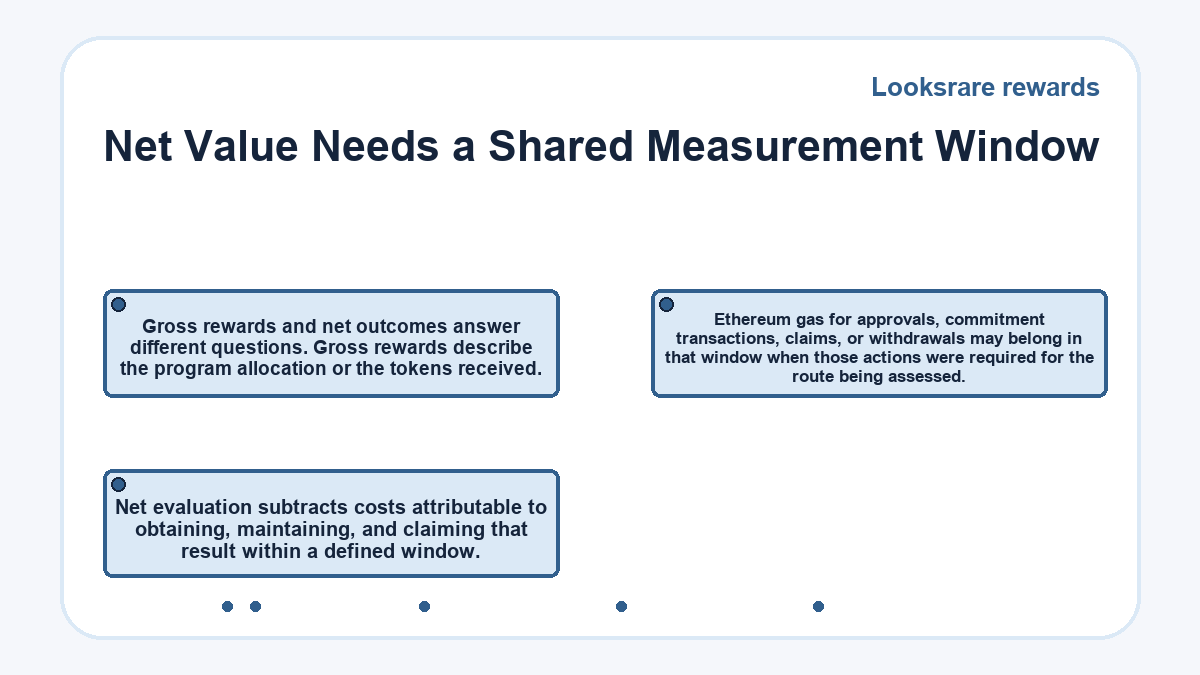
Gross rewards and net outcomes answer different questions. Gross rewards describe the program allocation or the tokens received. Net evaluation subtracts costs attributable to obtaining, maintaining, and claiming that result within a defined window. Ethereum gas for approvals, commitment transactions, claims, or withdrawals may belong in that window when those actions were required for the route being assessed.
A failed on-chain action may still consume gas even though it transfers no reward. Conversely, a displayed pending amount has not yet incurred the future claim cost. Mixing those states makes one path appear cheaper or more productive simply because its execution is incomplete.
Keep unlike assets in their native units unless a common valuation is needed. If conversion is necessary, use one stated observation time and one consistent pricing basis for both rewards and costs. Token price changes after receipt are separate from the protocol’s recorded distribution result. Opportunity cost can inform a personal decision, but it is not an on-chain fee or a guaranteed loss.
How Does a Recorded Result Become Observable?
A recorded result becomes observable when the relevant transaction enters a block with a successful receipt and the expected contract or token state changes. The transaction target identifies the contract called, the status reports execution success or failure, and decoded events can show the action and amount. Token balances provide a second check when the route transfers rewards to the wallet.
The application may update later because its indexer must process the new block. A stale dashboard beside a successful receipt is therefore different from a failed transaction. If no transfer appears, inspect whether the selected route retains the reward inside a contract, compounds it into the committed position, or names another reward asset. Those possibilities must come from the live route rather than an old program description.
Program Status Separates Current and Historical Figures
The current protocol route begins with committed LOOKS. Its visible totals can describe committed tokens, earned rewards, or participating addresses, but each label has a separate denominator and purpose. A site-wide total cannot be copied into one wallet’s result.
Historical trading rewards used qualifying marketplace volume to allocate LOOKS. Their formulas remain useful for interpreting old claims and records. They do not supply a current rate, and earlier trading activity should not be treated as newly accruing rewards.
Listing rewards followed a separate eligibility and scoring system before discontinuation. An old listing score was an input to that program, not a token balance. It should remain attached to its original period and never be added directly to a live protocol-reward amount.
A Gems season used relative participation and a season-specific reward pot, so a Gem count was not itself a fixed LOOKS amount. A completed season can retain rankings or claimed totals after its earning period ends. The season label and redemption status determine what that display means.
These distinctions matter most when exporting records. Store the program name, wallet, asset, state label, observation boundary, transaction hash when available, and attributed cost together. Separate rows allow historical campaigns and current participation to coexist without suggesting that every displayed number remains claimable.
Next Actions by Matched State
A pending estimate calls for another observation after its governing input updates. A current claimable balance calls for a cost check and an accurate wallet prompt. A successful receipt calls for reconciliation against the transfer or retained contract balance. An archived figure remains historical unless its own valid claim path still accepts the wallet. That distinction prevents a changing display from being mistaken for a completed return.
Looksrare rewards questions worth asking
Can an Archived Reward Figure Still Be Claimed?
Archived trading and listing reward figures can no longer be claimed because their claim window closed on February 1, 2024. A figure from another archived program is claimable only if its original route still accepts that wallet’s entitlement. Check the program name and claim state before signing any transaction; a visible historical balance, score, or formula does not establish availability.
Does a Failed Claim Reduce the Displayed Reward Balance?
A displayed reward balance may change while the interface refreshes, but a failed claim does not by itself show that the entitlement decreased. The submitting wallet may still spend gas. Use the failed receipt and the subsequent contract state to determine whether the entitlement remains before attempting another transaction.
Can a Screenshot Prove That a Reward Was Received?
A screenshot can preserve what an interface displayed at a particular moment, but it cannot prove settlement by itself. Proof of receipt requires the matching wallet, successful transaction record, reward asset, and resulting transfer or contract-state change. Keep the screenshot as presentation evidence rather than treating it as the ledger record.
Why Might a Portfolio Tracker Show a Different Reward Amount?
A portfolio tracker may use another indexer, block height, asset list, or accounting rule. It might include wallet-held tokens while excluding rewards retained in a contract, or it may display cached data. Compare both tools at the same observation boundary before deciding that either amount is incorrect.
Can Committing More LOOKS Guarantee a Larger Net Outcome?
Committing more LOOKS does not guarantee a larger net outcome. The result can depend on the live distribution inputs, total participation, reward funding, execution costs, and the route’s current rules. A larger recorded commitment establishes more committed tokens; it does not establish a fixed return or future token value.
Updated: